Market-Day Manners: A Two-Point Walking System for Leonbergers in Busy UK Towns
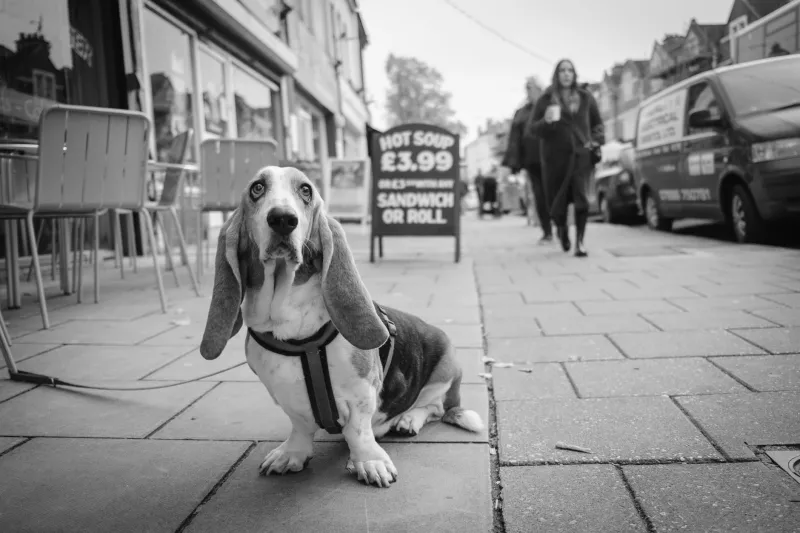
A Leonberger on a quiet towpath is one thing. A Leonberger on a packed high street, outside a bakery, with a pram on one side and a market stall on the other, is a different job entirely. At around 60kg, your dog is not being difficult when he drifts into the flow of shoppers; he is simply big enough to occupy the same space as three ordinary dogs. The answer is not a tighter collar or a firmer voice. It is a walking system that gives you two points of control and gives him a clear picture of where he is meant to be.
Two points of contact, not two flailing leads
Start with a proper Y-front harness that leaves the shoulders free. A collar alone is fine for a tag and a quick garden trip, but it is not the tool for steering a giant breed through a crowd. Then use a double-ended lead: one clip on the front chest ring, one on the back ring. That is your two-point setup. It is not two separate leads, and it is certainly not a retractable lead. A fixed-length lead of about 1.5m to 2m, with a spare loop or two to gather when you need to shorten up, is far more useful.
The front clip does the steering. If your Leonberger leans towards a sausage roll counter, the front attachment gently turns his chest rather than cranking his neck. The back clip adds a steady brake. Hold the handle in your stronger hand, keep the lead slack in normal walking, and gather it short only when you are passing people, waiting at a kerb or squeezing past a shop doorway. Check the harness fit every few weeks, especially with a young dog, and make sure you can still slide two fingers under the straps without wrestling.
Add an emergency handle on the top of the harness if yours does not already have one. This is not a carrying handle for a 60kg dog; it is a stabiliser. Practise reaching for it at home, with a treat, so your hand finds it without a scramble. In a tight spot, you can hold the handle and the lead together, keep your dog close to your leg and move him out of the way without a tug-of-war.
Teach the park position before the crowd arrives
Park is the most useful town cue you can teach a big dog. It means stand or sit tight beside you, parallel to a wall or kerb, with his head neutral and his body out of the traffic lane. You are not asking for a formal show stand. You are asking for a portable parking space.
Start in a hallway or garden. Lure your Leonberger into position beside your leg, reward, and build up to a few seconds. Add the word park, then a release word such as walk on. Practise next to a wall, then beside a bench, then on a quiet pavement. In town, park is what you use at the crossing, outside the chemist, while a delivery bike goes past and when someone stops to ask about the dog. It gives everyone a clear route around you and gives your Leonberger a job to do instead of leaning into the nearest pair of legs.
Build crowd skills in small doses
Do not begin with the Saturday market at eleven o'clock. Begin across the road from it, on a quiet side street, at a distance where your dog can still take a treat and respond to his name. Watch for the early signs: yawning, lip licking, a lowered tail, shifting weight, or a sudden interest in every scent mark. Those are your cues to stop, park and create space, not to push on and hope he settles.
Once he is comfortable at a distance, move one notch closer. Try the school run after the main scrum has gone, or the market at opening time before the crowds build. Reward him for checking in with you, and keep sessions short. A good ten-minute town walk with three successful passes is worth more than a forty-minute endurance test. If he stops taking treats or starts trying to park himself under a bench, call it. Town confidence is built over weeks, not forced in one afternoon.
Pavement etiquette for a very large dog
In busy British towns, keep your lead short and your dog on the side away from the kerb where possible. At pinch points, doorways and bus queues, use park and let people pass. Do not let him block a shop entrance, even if he is sitting beautifully. Carry poo bags, obviously, and keep a high-vis slip or lead cover handy in the darker afternoons.
When someone asks to pet him, you are allowed to say no. A cheerful 'Sorry, he's in training' works well, and stepping between your dog and the admirer is not rude; it is good management. Children should always ask first, and a big dog should never be expected to stand still while a stranger leans over his head. At cafés, tuck him under the table or beside your chair, not in the waiter's path. At crossings, teach a wait at the kerb before you step off. And if you use a pedestrianised area, pick a side and stick to it so you are predictable to cyclists, scooters and everyone else trying to get past.
The kit list is simple: well-fitted harness, double-ended lead, emergency handle, treat pouch and a pocket full of rewards. The mindset is simpler still. You are not trying to march a lion through a market. You are giving him a small, clear route through it, one parked moment at a time.