The Sixty-Kilo Passenger: A Practical Car-Safety Audit for Leonberger Owners
Start with the boring bit: your car’s actual limits
A Leonberger can weigh around 60kg before you add a crate, a water bowl, a towel and the weekly shop. That means car travel starts with arithmetic, not enthusiasm. Before you buy any restraint kit, check your vehicle’s gross vehicle weight, kerb weight and payload. The payload figure is the maximum you can safely add for passengers, luggage and the dog. A large crate can easily add 20–30kg, so a car that feels roomy with one person aboard may be close to its limit with a full family and a giant breed in the boot.
Next, measure the boot properly. You need height from the boot floor to the lowest point of the tailgate opening, width between the wheel arches, depth from the rear seats to the tailgate, and the height of the loading lip. Do not forget the slope of the tailgate glass — a crate that fits on paper may not fit once the door is closed. For a Leonberger, the crate or harness space should let the dog stand naturally, turn around and lie flat. If the dog has to fold itself in like a deckchair, it is not suitable for longer journeys.
The three main restraint choices — and what they actually do
Crash-tested crates
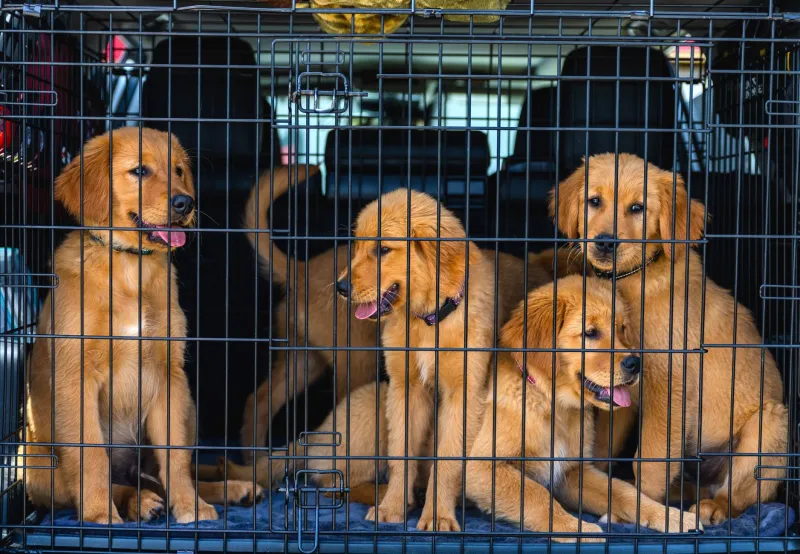
A properly crash-tested crate is the gold standard for many giant-breed owners, but only if it is the right size and fitted correctly. Look for independent crash-test evidence, not just the word ‘strong’ on a website. The crate should be secured to the vehicle’s anchor points and should not rely on the tailgate to stay in place. In an estate or SUV, a crate also contains drool, mud and loose hair, which is a genuine practical bonus. The trade-off is weight, cost and the space it takes up even when empty.
Crash-tested harnesses
A harness is easier to store and gives the dog a bit more room to settle, but it must be designed for car travel and tested to a recognised standard. A normal walking harness is not a crash restraint. The harness needs to fit snugly without rubbing, and it should attach to a seatbelt or compatible anchor system according to the manufacturer’s instructions. For a 60kg Leonberger, check the weight rating carefully. A harness that is fine for a Labrador may not be rated for your dog.
Tailgate guards and boot dividers
A tailgate guard stops a dog from leaping out when the boot opens, and a divider keeps the dog in one part of the boot. Both are useful management tools, but they are not the same as crash protection. A guard may keep the dog inside the load area in normal driving, yet it will not necessarily prevent injury in a collision. Think of these as secondary measures, not a substitute for a tested crate or harness.
What the Highway Code and insurers expect
Rule 57 of the Highway Code says dogs must be suitably restrained so they cannot distract you while driving or injure you or themselves if you stop quickly. It is not a detailed specification, but it gives you the principle: the dog should be secure, comfortable and unable to climb into the front. Your insurer may also have its own conditions. Some policies expect dogs to be restrained; others may reduce cover or refuse a claim if an unrestrained dog contributed to an accident. Check your policy wording before you travel, and if you are unsure, ask the insurer directly. This is not legal advice — it is a prompt to read the small print.
Loading and unloading without drama
A Leonberger should not be asked to jump into a high boot or leap out onto wet tarmac. Use a ramp with a non-slip surface where possible, and teach the dog to walk up and down calmly before you need it on a dark November morning. Keep a lead on until the dog is secured or the boot is closed. When unloading, open the tailgate only when you have hold of the lead and the dog is calm. A 60kg dog surging forward can knock a person off balance, especially on a slope or in a busy car park.
Car sickness, drool and the reality of a wet Leonberger
Some giant breeds travel well; others are less keen. Build up journeys gradually, use ventilation without blasting cold air directly at the dog, and avoid a heavy meal immediately before travel. If your dog is consistently sick or very stressed, speak to your vet rather than relying on random internet remedies. For drool, keep a dedicated travel towel and a washable boot liner. A rubber mat under the crate or harness area helps stop sliding and makes cleaning easier. Do not leave a dog loose in the car with a bowl of water sloshing about — offer water at breaks instead.
Estates, SUVs and smaller family cars
Estates often suit Leonbergers well because they have a long, low boot and a manageable loading lip. SUVs give height and easier access for some owners, but check the payload and the tailgate opening — a high floor can be harder for an older dog. Smaller family cars can work if the dog travels on the rear seat in a crash-tested harness and the boot is used for gear, but that means everyone else travels light. Never put a Leonberger in a roof box, a trailer or an unventilated hatchback space. If the car cannot fit the dog, the crate and the family safely, the honest answer is to change the car or change the plan.
A winter checklist for dark, wet journeys
Before you set off in winter 2026, check the crate or harness fittings, pack a torch, reflective lead and towel, and keep a breakdown plan that includes the dog. Do not leave a Leonberger alone in a cold car for long periods, and never leave any dog in a car in warm weather. On wet journeys, dry the paws and belly at the other end to reduce mud and slipping. Finally, give yourself extra time. A giant breed does not do rushed loading, and a calm routine is safer for everyone — dog, driver and the person holding the lead.